


LLP Registration in the UK
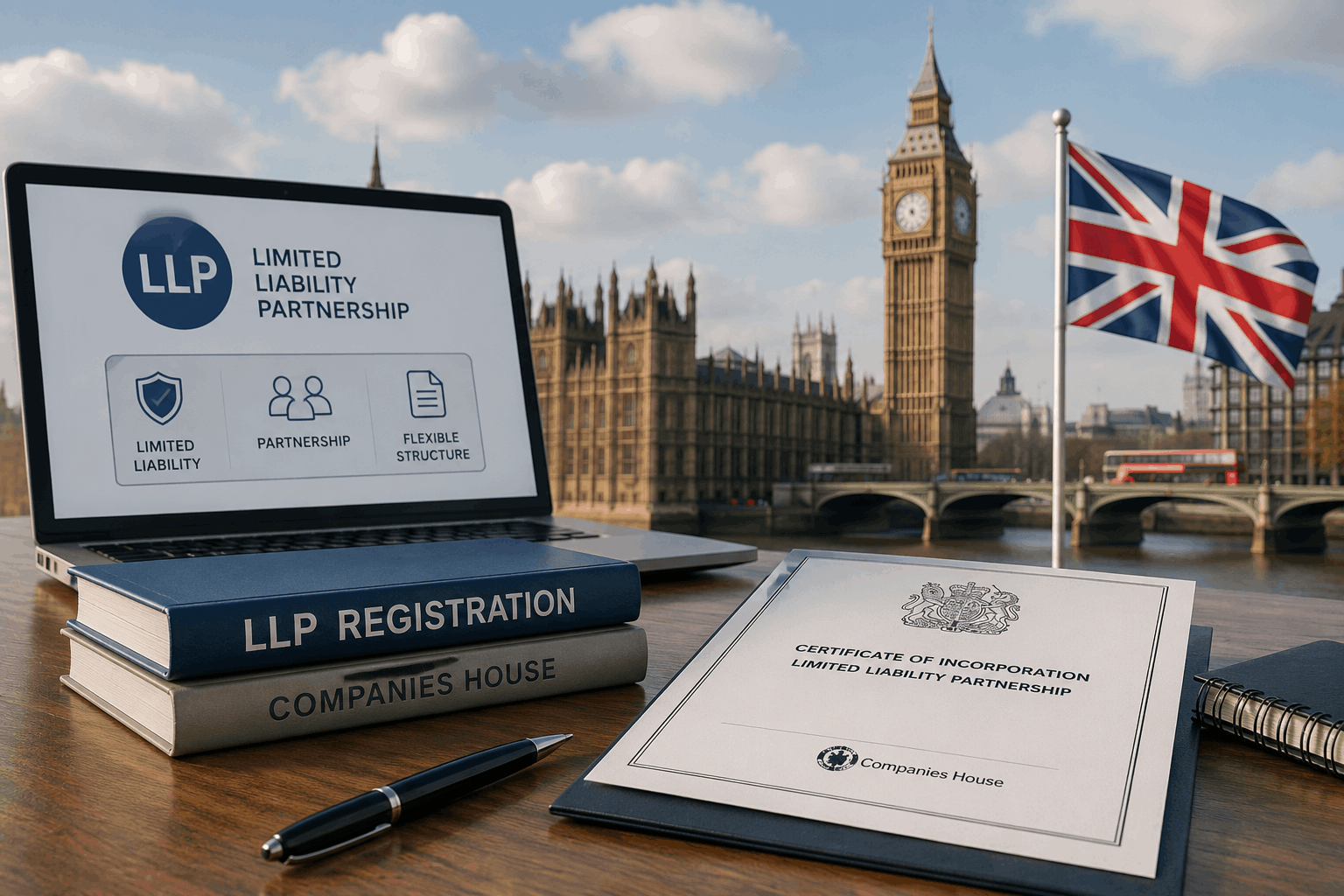
- An LLP combines the flexibility of a partnership with limited liability protection—your personal assets are not liable for the company's debts.
- Registration via Companies House takes as little as 24 hours, though fully setting up the structure, including a bank account, requires three to six weeks.
- A UK partnership pays tax only on profits generated within the UK; international income can remain outside the UK tax system.
- Operations require a local registered office and designated members, though non-residents can manage the LLP remotely.
- Annual maintenance includes filing reports with Companies House and HMRC; costs start at £500–£800 per year.
- An LLP is not suitable for every business model; it is important to analyze the tax implications in your country of residence.
What is an LLP, and why is this structure attractive to international business
A Limited Liability Partnership (LLP) is a hybrid business structure that combines the advantages of a partnership and a limited company. Unlike a standard partnership, where participants are liable with their personal assets, an LLP protects partners' assets from creditors' claims. At the same time, the structure remains transparent to tax authorities, which is crucial for legitimate international business.
UK law allows both UK residents and non-residents to establish an LLP. You can manage the partnership from anywhere in the world, provided that formal requirements regarding a local address and designated members are met. This flexibility makes the LLP a popular choice for consulting, IT projects, investment activities, and international trade.
Key differences between an LLP and a Limited Company
An LLP does not have share capital or shares in the traditional sense. Partners' shares are determined by an agreement between them, which does not require registration in public records. This offers greater confidentiality regarding profit distribution and the allocation of authority among partners compared to a standard company, where the share capital structure is visible via Companies House.
Taxation operates on a transparency principle: the LLP itself does not pay UK corporate tax on profits. Instead, each partner independently declares their share of income in their country of tax residence. For non-residents, this means that UK-generated profits are taxable only if the source of income is located directly within the UK.
When an LLP is the optimal choice
This structure is well-suited for professional services where the partners' individual expertise is key. Consulting firms, marketing agencies, IT development, and legal and financial services are traditional sectors for LLPs. The structure allows for the sharing of risk among partners while maintaining flexibility in income distribution.
Investment and holding structures also utilize LLPs to manage asset portfolios. Tax transparency helps avoid double taxation at both the entity and beneficiary levels. However, such arrangements require a careful analysis of tax treaties between the UK and the participants' countries of residence.
Requirements for members and partnership structure
Registering an LLP requires a minimum of two members. These can be individuals or legal entities from any jurisdiction. The law does not require British citizenship or residency, making the structure accessible to entrepreneurs from Russia, the CIS, and other countries.
At least two members must be appointed as "designated members"—partners with expanded duties. They are responsible for maintaining accounting records, filing annual reports with Companies House, and liaising with HMRC. Designated members bear additional responsibility for regulatory compliance, but this does not entail increased personal financial liability for the LLP’s obligations.
Documents for non-resident members
Each member must provide a copy of their passport and proof of residential address. Acceptable proof of address includes utility bills, bank statements, or official letters from government bodies issued within the last three months. If documents are in Russian or another language, a notarized English translation with an apostille is required.
Corporate members must provide a full set of registration documents—such as the certificate of incorporation, articles of association or partnership agreement, and a list of directors and beneficial owners. Requirements for corporate documents vary by jurisdiction, but the general principle remains the same: one must verify the company's legal existence and the authority of the individuals acting on its behalf.
Registered office and service address
An LLP is required to have a registered office in the UK. This is the official address where Companies House and government agencies send correspondence. Using a personal home address is not mandatory; most entrepreneurs rent a registered office from specialized providers. This address will appear in the public register.
A "service address" is the address used for contacting each designated member. It may differ from the registered office and can be located outside the UK. To maintain personal address privacy, one can use the same address as the registered office or the address of a professional service provider. H2 Step-by-step registration process via Companies House
Registration begins by checking the availability of a name for your LLP. The name must be unique and cannot duplicate existing trademarks or the registered names of other companies. You can check availability for free via the Companies House online system. The name must end with "Limited Liability Partnership" or the abbreviation "LLP".
Once a name is chosen, form LL IN01—the primary incorporation document—is prepared. It lists details regarding all members, designated members, the registered office, and the principal business activity. The form can be submitted online via the WebFiling service or sent by post as a paper version. Online registration is faster and cheaper (£10 compared to £40 for paper filing).
Payment and document receipt timelines
After the form is submitted and payment is made, Companies House reviews the documents and assigns a registration number. With online filing, the certificate of incorporation usually arrives within 24 hours. Paper registration takes eight to ten working days. Along with the certificate, you receive a confirmation statement and official confirmation of the registered office.
You will need the registration number for all subsequent actions—opening a bank account, registering with HMRC, and signing contracts on behalf of the LLP. Keep all documents received from Companies House in a secure place. Losing the certificate of incorporation will create problems when dealing with banks and business partners.
Registration with HMRC for tax purposes
After receiving the certificate of incorporation, you must register the LLP with HM Revenue & Customs (HMRC). This is done online using form SA400 for the partnership tax return. Registration is required even if the partnership does not plan to conduct business in the UK and will not have UK-sourced taxable income.
HMRC assigns a Unique Taxpayer Reference (UTR), which is an identification number for tax purposes. The UTR is sent by post to the registered office within ten working days. Without this number, it is impossible to file annual tax returns, so it is important to register immediately after incorporation without delaying the process.
Partnership Agreement and Internal Governance
The partnership agreement is the primary document governing relationships within an LLP. The law does not require this agreement to be filed in public registers, allowing the terms to remain confidential. The agreement outlines each partner's share, profit distribution methods, decision-making mechanisms, and procedures for the admission of new partners or the withdrawal of existing ones.
In the absence of a written agreement, the default rules set out in the Limited Liability Partnerships Act 2000 apply. By default, all partners have equal rights regarding profits and management, regardless of capital invested or actual contribution to the work. As this may not reflect the partners' actual arrangements, legal professionals always recommend drafting a detailed partnership agreement.
Critical Points for International Partners
The agreement must clearly specify the governing law applicable to the partners' relationship. For an LLP registered in the UK, it is logical to choose English law, though the parties may agree to apply a different legal system. It is also important to define the dispute resolution mechanism—such as arbitration or the jurisdiction of specific courts—and the applicable procedure.
Each partner's tax obligations depend on their residency status and the source of their income. The agreement can specify who is responsible for preparing tax documentation and who pays for accounting and tax advisory services. This is particularly important for partners from different countries, as reporting requirements can vary significantly.
Rights and Obligations of Designated Members
The agreement should detail the powers of "designated members." They are authorized to sign documents on behalf of the LLP, represent the partnership in dealings with third parties, and update registration details with Companies House. It is also important to establish limitations—specifying which decisions designated members may make independently and which require the consent of all partners.
Designated members may face fines of up to £1,000 for failing to fulfill their record-keeping and reporting obligations. The agreement may also provide for a compensation mechanism for designated members should they incur additional costs or risks associated with their status.
LLP Tax Residency: Hidden Risks for Partners from the CIS
A company’s place of registration does not always determine its tax residency. A UK LLP may be deemed a tax resident of Russia or another CIS country if its center of management and control is located there. This occurs when key decisions are made by partners based in Russia, and corporate documents are kept and regular meetings are held there.
Dual tax residency creates an obligation to report income and potentially pay taxes in both jurisdictions. The double taxation treaty between the UK and Russia includes "tie-breaker rules," but applying them requires proactive steps by the taxpayer and can lead to lengthy disputes with tax authorities.
To mitigate these risks, it is essential to document that strategic decisions are made in the UK. Measures might include holding board meetings with UK-based advisors, engaging UK lawyers and accountants to prepare key documents, and ensuring the physical presence of at least one partner in the UK to perform management functions.
An alternative approach is to openly acknowledge tax residency in the country of actual management and structure the LLP as a transparent entity for international operations. In this scenario, the partnership serves to limit liability and facilitate contractual arrangements, rather than to achieve tax optimization.
Opening a Bank Account for an LLP
UK banks implement rigorous "Know Your Customer" (KYC) and anti-money laundering (AML) compliance procedures. For LLPs with foreign partners, the account opening process takes between four and eight weeks. Banks require proof of the source of funds, a business plan, projected turnover figures, and detailed information on each partner and beneficial owner.
Traditional banks such as Barclays, HSBC, or Lloyds often refuse service to non-resident entities that lack a significant UK presence. Specialized providers for international business—such as Wise Business, Revolut Business, and Payoneer—serve as alternatives, though they impose limits on transaction amounts and operation types.
Required Bank Documentation
The standard documentation package includes the certificate of incorporation, the partnership agreement, proof of the registered office address, and a list of all members and designated members, accompanied by their identity documents. Banks also require proof of address for every individual associated with the LLP. For corporate members, the full chain of ownership leading to the ultimate individual beneficiaries must be disclosed.
Most banks request a business plan outlining business activities, expected turnover, and key clients and suppliers. If you plan to deal with cryptocurrencies, operate in high-risk jurisdictions, or run a cash-intensive business, be prepared for additional inquiries and a potential refusal. Banks avoid clients who pose elevated compliance risks.
Online Banks and Payment Systems
Alternative providers simplify the account opening process: applications are submitted online, verification takes just a few days, and there are fewer requirements for a physical presence. Wise Business and Revolut are suitable for standard operations, such as receiving client payments, paying suppliers, and currency exchange. Transaction limits are generally sufficient for small and medium-sized enterprises (SMEs).
Limitations arise when handling large sums or specific types of transactions. Payments to certain countries may be blocked, cash withdrawals are restricted, and options for overdrafts or credit products are unavailable. For serious business operations, it is recommended to maintain an account with a traditional bank as your primary account while using online providers as a supplement.
Annual reporting and compliance requirements
Every LLP is required to file a confirmation statement with Companies House at least once a year. This document confirms the accuracy of information regarding members, designated members, the registered office, and principal business activities. Failure to file or late filing incurs fines starting at £150, and the partnership risks being struck off the register.
Accounting requirements depend on the size of the partnership. Small LLPs are exempt from mandatory audits provided they meet specific criteria regarding turnover, assets, and employee numbers. However, even small partnerships must maintain proper accounting records and provide them to HMRC or other government bodies upon request.
Tax reporting for non-resident partners
Each partner receives their share of the LLP’s profits or losses and declares it in their country of tax residence. The partnership itself files a Partnership Tax Return with HMRC, detailing total income and its distribution among the partners. For non-residents, this does not create UK tax liabilities unless the income source is British.
If the LLP conducts business in the UK or derives income from UK sources, non-resident partners may become liable for UK income tax. In such cases, they must file a Self Assessment tax return and pay the tax by the relevant deadlines. Penalties for non-filing start at £100 and increase the longer the delay continues.
Annual maintenance costs
Minimum compliance costs include the filing fee for the confirmation statement—£13 for online filing. Registered office services cost between £100 and £300 per year, depending on the provider. If you engage accountants and lawyers to prepare your reports, expect to pay between £500 and £1,500 annually.
More complex structures involving international operations, high turnover, or specialized business activities require professional support. Comprehensive services, including tax planning, multi-jurisdictional reporting, and legal support, can cost between £3,000 and £10,000 per year.
Risks and pitfalls when operating a British LLP
Many entrepreneurs underestimate the requirements for "substance"—actual presence and business activity—in the jurisdiction of registration. If an LLP exists only on paper—lacking an office, employees, and genuine business activity in the UK—tax authorities in other countries may reclassify it as a tax resident based on its place of effective management.
A lack of proper documentation creates problems during tax audits and interactions with counterparties. If the partnership agreement is merely a formality, fails to reflect the partners' actual arrangements, or contains contradictions, it can lead to disputes and additional legal expenses.
Tax implications for residents of Russia and the CIS
Russian tax law requires residents to declare their worldwide income, regardless of where it was earned. A partner's share of profits from a British LLP is subject to personal income tax at a rate of 13% or 15%, depending on the amount. Failure to file a tax return results in fines and penalties, while the intentional concealment of income can be classified as a criminal offense.
Controlled Foreign Companies (CFCs) are another aspect to consider. If a partner's stake in the LLP exceeds 25% and the partnership meets CFC criteria, the Russian tax resident is required to declare the entity's profits and pay tax on them, even if the funds were not repatriated to Russia. These rules are complex and require consultation with a tax specialist.
Mistakes in choosing a banking partner
Relying solely on online banks limits business opportunities. Some clients and suppliers refuse to work with payment platforms like Wise or Revolut, insisting instead on an account with a traditional bank. Participating in tenders, obtaining loans, or establishing long-term partnerships requires a fully functional bank account.
Discrepancies between the business activities declared at registration and actual operations can lead to account blocking. Banks monitor transactions and may freeze funds for verification if they detect unexpected patterns. Transparency and the documentation of every significant transaction are the only ways to avoid problems.
Alternative structures and when they are preferable to an LLP
A Limited Company remains the most popular business form in the UK. If you plan to reinvest profits into growth rather than distributing them among partners, a corporate structure may be more efficient. The 25% corporation tax on substantial profits is still lower than the combined tax burden in some CIS countries.
Specialized structures—such as REITs for real estate and OEICs for collective investments—are often used for investment activities or property ownership. These forms benefit from special tax regimes that may be more advantageous than a general LLP, though they impose strict limitations on the type of activity and capital structure.
LLP versus a general partnership
A general partnership does not provide limited liability; each partner is personally liable for all obligations with their own assets. This form is rarely used and is suitable only for short-term, low-risk projects. For professional services or commercial operations, an LLP is undoubtedly preferable.
Registration and compliance for a general partnership are simpler and cheaper, but the savings do not justify the risks. The loss of assets resulting from a lawsuit or bankruptcy can far exceed the costs of registering and maintaining an LLP. Asset protection is one of the key reasons for choosing a limited liability partnership.
Offshore alternatives
Jurisdictions such as the Seychelles, the BVI, or Belize offer simpler registration procedures and fewer reporting requirements. However, the reputational risks associated with traditional offshore jurisdictions are rising. Banks and major counterparties view companies from jurisdictions with low transparency with suspicion, which complicates business relationships.
The UK offers a balance of prestige, a sophisticated legal system, and reasonable tax conditions. For serious international businesses planning long-term relationships with European and global partners, a UK LLP remains one of the best options, despite relatively high compliance requirements. If you need assistance with company registration or selecting the optimal jurisdiction, the specialists at IT-OFFSHORE are ready to provide expert advice.


