


Registering an IT company in Estonia via e-Residency
- Estonia’s e-Residency allows you to manage a company remotely but does not replace a residence permit or grant the right to physical presence in the country;
- The corporate income tax rate in Estonia is 20% and applies only when dividends are distributed, not when they are accrued; undistributed profits are not taxed;
- Opening a bank account for an Estonian company requires either a personal visit to the bank or the use of electronic payment services with simplified verification;
- Annual company maintenance—including accounting, a legal address, and financial reporting—costs between €1,200 and €2,500, depending on turnover;
- An Estonian company is suitable for IT businesses, consulting, software development, and e-commerce, but requires genuine operational activity to establish tax residency;
- A non-resident can serve as a director, though having a local director who is an EU resident simplifies the process of opening accounts and interacting with banks.
What is Estonian e-Residency?
The e-Residency program was launched in Estonia in 2014 as a tool to attract foreign entrepreneurs. It allows anyone from any country to obtain a digital identity and manage a business within the EU remotely.
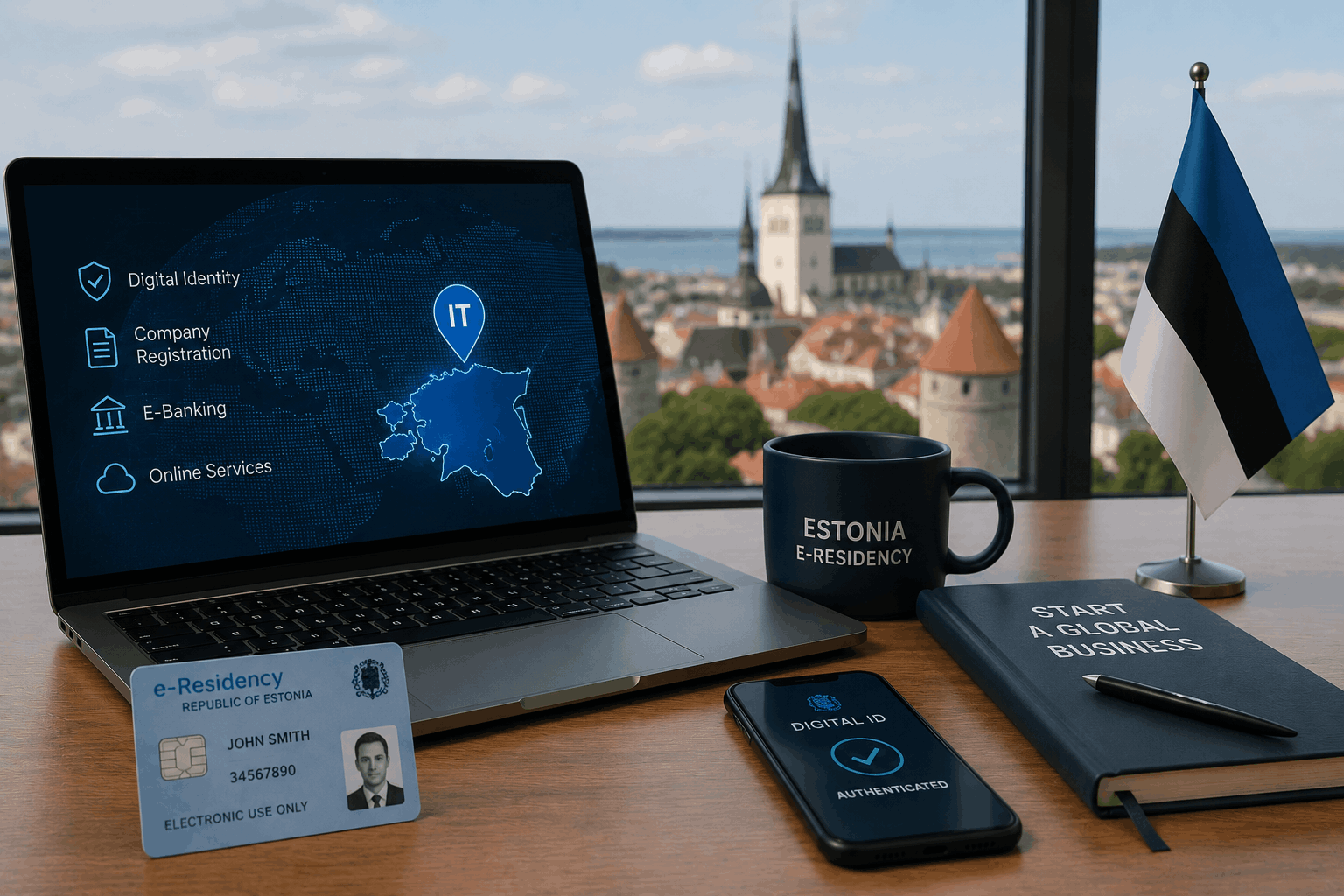
An e-resident receives a special chip-enabled ID card that functions as a digital signature. It allows holders to sign documents, incorporate a company, file tax returns, and handle accounting via Estonian government portals. The entire process takes place online, requiring no physical presence in the country once the card has been obtained.
It is important to understand that e-Residency does not grant the right to live in Estonia, cross the EU border, or receive social benefits. It is strictly a business tool. You remain a tax resident of your home country and are obligated to pay taxes where you reside for the majority of the year.
Who is the e-Residency program for?
The program was created primarily for digital entrepreneurs—such as software developers, designers, consultants, and online store owners. For them, Estonia offers a simple registration process, a clear tax system, and fully digital interaction with government authorities.
If your business involves providing services to EU clients, registering a company in Estonia grants access to the European market without complex procedures. Operating as a European company boosts client trust and simplifies contractual arrangements.
For IT startup founders, the Estonian jurisdiction is attractive due to its developed ecosystem, which includes venture capital funds, tech accelerators, and an active entrepreneurial community. Furthermore, Estonia is recognized by major international payment systems as a reliable jurisdiction.
Limitations and specifics of e-resident status
E-Residency does not automatically resolve tax matters. If you live in Russia or another CIS country for the majority of the year, you remain a tax resident of that country. Income generated by an Estonian company may be subject to taxation in your country of actual residence.
Banks scrutinize e-residents closely. Opening an account requires a detailed explanation of the business model, sources of income, and planned transactions. Some banks refuse service to companies that lack a physical presence in Estonia or a local director.
An Estonian company cannot be used merely as a shell entity for transferring funds. Tax authorities across different countries actively exchange information, and sham structures are quickly detected. The company must engage in genuine business operations and have contracts, employees, or contractors in place.
The e-Residency application process
Applications are submitted via the official e-Residency portal. You will need to upload a scan of your passport, state your reason for seeking the status, and pay the state fee. The processing cost ranges from €100 to €120, depending on the method of card collection.
Application review takes between two weeks and two months. The Estonian police verify the applicant's details against international databases. Applications may be rejected due to a criminal record, links to sanctioned entities, or a questionable business reputation.
Once approved, you will receive a notification and can collect your card from a designated pickup location. These locations include Estonian embassies and specialized centers in major cities worldwide. Alternatively, you can opt for courier delivery, though this increases both the waiting time and the cost.
Card activation and access to services
The card must be activated within one year of receipt. Activation requires a special card reader—a device for reading the chip. You can purchase one from the program's official website or from certified suppliers. The cost of a card reader is approximately 50–70 euros.
Once activated, you gain access to the e-Business Register portal (for company registration) and the e-Tax Board system (for filing tax returns). All operations are performed via a web browser using a digital signature.
The card is valid for three years, after which renewal is required. The renewal process is simpler and faster than the initial application. The cost of renewal is approximately 100 euros.
Registering an IT company in Estonia
The most common legal form for IT businesses is the OÜ (private limited company). It is analogous to the Russian LLC: shareholders are liable for obligations only up to the amount of their contributions, and the company itself is a separate legal entity.
Registering an OÜ requires a minimum share capital of 2,500 euros. Of this amount, 25% must be paid in before registration, while the remaining 75% can be contributed over the course of three years. In practice, many entrepreneurs pay the full amount upfront to avoid additional formalities.
The registration process via the e-Business Register portal takes anywhere from a few hours to three business days. You fill out an electronic form specifying the company name, business activities, address, and details of the director and shareholders. Once the registrar verifies the data, the company is entered into the Commercial Register.
Requirements for the director and company address
The director can be any individual, including a non-EU resident. However, having a director who is a resident of Estonia or another EU country significantly simplifies dealings with banks and business partners. Many banks require at least one director to be an EU resident.
The company is required to have a registered office address in Estonia. You cannot use the e-resident's home address located in another country. Entrepreneurs typically rent an address from specialized service providers that offer registered office and mail-handling services. The cost of such a service ranges from €200 to €500 per year.
If you are planning a substantial business with a turnover of several hundred thousand euros, it is worth considering renting an actual office. This enhances the company's reputation, simplifies banking relationships, and reduces risks during tax audits.
Business activities and NACE codes
During registration, you must specify NACE codes—the European classification of economic activities. IT companies typically select codes related to software development, consulting, web design, or the provision of digital services.
The choice of codes affects future licensing requirements and how banks perceive the company. An overly broad list of codes raises suspicions, while one that is too narrow may limit business operations. It is best to select 3–5 codes that accurately describe the planned business.
Certain business activities require special licenses, such as financial services, education, healthcare, and large-scale personal data processing. Standard IT companies providing development or consulting services do not require licenses.
Taxation of an Estonian IT company
A key feature of the Estonian system is deferred profit taxation. The 20% tax is payable not when the profit is earned, but when it is distributed as dividends. As long as the profit remains within the company and is reinvested in development, no tax is levied.
This model makes Estonia attractive to growing IT companies that reinvest their earnings into product development, marketing, or team expansion. You pay taxes only when you withdraw funds for personal use.
When dividends are paid to a non-EU resident, a withholding tax—also at a rate of 20%—is applied. The final tax burden depends on whether a double taxation avoidance agreement exists between Estonia and your country of tax residence. Such an agreement is in place between Estonia and Russia, allowing Estonian tax paid to be credited against income declared in the Russian Federation.
VAT and Value Added Tax Reporting
If a company’s annual turnover exceeds €40,000, VAT registration is mandatory. The VAT rate in Estonia is 22%, which is higher than in many other European countries. For IT services provided to clients in other EU countries or outside the EU, the "reverse charge" mechanism often applies, meaning the buyer pays the VAT.
VAT returns are filed monthly via the e-Tax Board system. While the process is relatively straightforward, it requires accurate record-keeping of all transactions and the correct classification of services based on the buyer's location.
For companies dealing exclusively with corporate clients in the EU (B2B), VAT generally does not create an additional burden thanks to the reverse charge mechanism. Complications arise when selling services to private individuals or to companies based outside the EU.
Payroll taxes and social contributions
If an Estonian company employs staff, social taxes must be paid on their salaries. The social tax rate is 33% of the gross payroll, in addition to contributions for mandatory health insurance and pension savings.
A company director who is also the sole shareholder can choose not to pay themselves a salary, thereby avoiding social taxes. Instead, they can receive dividends. However, this means having no social insurance coverage in Estonia, a factor that should be taken into account.
Hiring remote contractors from other countries—either as self-employed individuals or through their own companies—allows a business to avoid Estonian payroll taxes. The company simply pays invoices for services rendered. This approach is common in the IT industry and is entirely legal, provided the contracts are properly structured.
Opening a bank account
Obtaining a bank account is one of the most challenging steps. Estonian banks, such as LHV and Swedbank, require an in-person visit for identity verification. An alternative is to use fintech services like Wise, Paysera, or Revolut Business, which allow accounts to be opened remotely.
Fintech platforms are easier to set up but come with limitations, such as transaction caps, geographic restrictions, and occasional issues with accepting payments from specific clients. They are, however, well-suited for small businesses with an annual turnover of up to €100,000–€200,000.
For large sums and significant business operations, it is better to open an account with a traditional bank. This requires preparation, including a detailed business plan, a description of revenue sources, client contracts, and the owners' CVs. The bank may also request references from other financial institutions or business partners.
Bank requirements for e-residents
Banks are wary of Estonian companies being used for cashing out funds, money laundering, or circumventing sanctions. Consequently, the vetting process is particularly rigorous if the company owner is a citizen of Russia or another high-risk country. You will be asked to explain why you chose Estonia specifically, where your clients are located, how you plan to conduct operations, and the source of your funds. The more detailed and transparent your answers, the higher your chances of approval.
Having a local EU-resident director significantly increases the likelihood of opening an account. Banks view this as a sign of a genuine business rather than just a remote shell company. Some entrepreneurs hire a nominee resident director specifically for this purpose, even though it adds €1,000–€2,000 in annual costs.
Alternatives to traditional bank accounts
In addition to Wise and Paysera, there are platforms specialized for e-residents, such as Payoneer, TransferWise for Business, and N26 Business. They offer multi-currency accounts, easy integration with accounting software, and relatively low fees.
Some platforms allow you to obtain local account details in various countries, which is convenient when working with clients in the US, the UK, or other regions. Clients see familiar account details, making them more willing to transfer funds.
It is important to verify whether your chosen platform supports your country of residence and allows for convenient fund withdrawals. Some services block transactions involving certain jurisdictions or require additional documentation for large transfers.
EXPERT OPINION
Alexander Kovalchuk, international tax planning specialist:
"An Estonian company operates effectively only if the entire structure is set up correctly. You cannot simply register an OÜ and forget about taxes in your home country. If you manage the company from Russia, live there for most of the year, and make key decisions from there, the tax authorities may deem the company a Russian tax resident. In that case, profits would be taxed according to Russian rules, regardless of the fact that the company is registered in Estonia.
Effective optimization requires a strategy that considers where you live, where your clients are based, how contracts are structured, and how functions are distributed among the participants." Sometimes it makes sense to combine an Estonian company with other jurisdictions—such as the UAE or Georgia—to achieve comprehensive protection and legitimate tax optimization.
Substance is also critically important: a physical office, employees, and verifiable business activity. A mere "paper" company lacking a genuine presence in Estonia raises questions for tax authorities in any country".
Bookkeeping and Reporting
An Estonian company is required to maintain accounting records and submit annual financial statements. Reports must be filed even if the company has had no business activity. The filing deadline is June 30 of the year following the reporting period.
You can handle bookkeeping yourself using specialized online platforms like Merit Aktiva or Taavi. These integrate with bank accounts, automatically import transactions, and generate the necessary reports. The interface is available in English, making it accessible to foreigners.
Most e-residents prefer to outsource their bookkeeping. Many companies in Estonia specialize in serving e-residents. Costs depend on transaction volume: ranging from €80–100 per month for simple cases to €300–500 for companies with active operations.
What Bookkeeping Services Include
A basic package typically covers recording bank transactions, preparing quarterly and annual reports, filing VAT returns, and providing consultations on day-to-day matters. Some providers offer additional services, such as preparing client invoices, managing accounts receivable, and monitoring payment deadlines.
When choosing an accountant, look for experience specifically with e-residents and IT companies. Digital business has unique characteristics compared to traditional business, and not all accountants are equally knowledgeable about international transactions, VAT on digital services, or working with contractors from various countries.
Be sure to clarify the language of communication. Many Estonian accountants speak fluent English, and some speak Russian. This is important for the quick resolution of day-to-day issues.
Tax Returns and Deadlines
The annual tax return is filed at the same time as the financial statements—by June 30. If the company is liable for VAT, returns must be filed monthly by the 20th day of the month following the reporting period.
If the company has employees, additional reports regarding payroll taxes must be filed. This is a monthly obligation, and late filing incurs penalties. Automated accounting systems help ensure deadlines are met by sending reminders.
Penalties for late reporting start at €100 and increase based on the length of the delay. Serious violations can result in the company’s bank account being frozen or the company being removed from the business register.
Practical aspects of operating an Estonian company
Managing a company via e-Residency is technically convenient but requires discipline. All documents must be digitally signed, and all operations are conducted online. This means that losing your e-Residency card or forgetting your PIN code can bring operations to a standstill.
Keep backup copies of all important documents and have a contingency plan for technical failures. The card replacement process takes several weeks, during which time you will be unable to sign documents on the company's behalf.
If the company works with clients from Russia or the CIS, be prepared for additional questions from them. Some Russian companies are wary of transferring funds to Estonia due to sanctions or currency control complexities. It is advisable to prepare an explanation in advance regarding how settlements will be handled and what documentation is required for international payments.
Working with counterparties from different countries
An Estonian company registered in the EU enjoys advantages when working with European clients. They recognize the familiar legal structure, the European VAT number, and the transparent jurisdiction. This builds trust and simplifies the process of concluding contracts.
When working with US clients, registration with the IRS and obtaining an EIN (US tax ID) may sometimes be required. This is necessary if a US company requests a W-8BEN-E form to verify your status as a foreign entity. The procedure is simple and free of charge, but it does take time. When dealing with Asian markets—such as Singapore, Hong Kong, and Japan—an Estonian company is also viewed positively as a European entity with transparent regulation.
Asset protection and confidentiality
Information regarding the owners of Estonian companies is publicly available in the commercial register. Anyone can view the company's shareholders, directors, address, and business activities. There is no confidentiality of ownership here.
If anonymity is a priority, additional structures must be used, such as nominee directors, or trust or holding companies in other jurisdictions. However, this complicates the corporate structure and increases maintenance costs.
In terms of asset protection, an Estonian limited liability company shields the shareholders' personal assets from claims by the company's creditors. The reverse protection—safeguarding company assets against the shareholders' personal debts—is less robust and depends on specific circumstances.
Alternatives to an Estonian company for IT businesses
Before registering a company in Estonia, it is worth considering other options. Cyprus, Ireland, or the Netherlands may be better suited to certain business models.
Cyprus offers one of the lowest corporate tax rates in the EU (12.5%), along with an extensive network of double taxation treaties. For companies planning to pay dividends, this can be more advantageous than the Estonian model.
The UAE and Georgia attract businesses with zero corporate tax rates in specific zones or under certain conditions. These are excellent options for entrepreneurs willing to relocate or spend significant time there.
The US—particularly states like Delaware, Wyoming, or Florida—offers straightforward LLC registration and, under certain conditions, no state-level corporate tax. A US company provides access to local bank accounts, payment systems, and investors.
Multi-jurisdictional structures
Multi-tiered structures are often used for substantial international businesses. For example, an Estonian operating company to serve European clients, a Cypriot holding company to optimize dividend payouts, and personal tax residency in a country with a territorial tax system.
Such arrangements require professional planning and constant monitoring of legislative changes. International tax law is evolving rapidly, with new rules emerging regarding information exchange, economic substance requirements, and anti-avoidance measures.
It is crucial that the structure is not merely formally correct but also economically justified. Tax authorities in various countries are increasingly challenging artificial schemes created solely to reduce taxes without a genuine business purpose.
Registration and maintenance costs
The total cost of setting up an Estonian company from scratch comprises several elements: obtaining e-Residency, company registration, contributing share capital, opening a bank account, securing a legal address, and initial accounting setup.
Obtaining e-Residency costs €100–€120. The state fee for company registration is approximately €190. The minimum share capital is €2,500, of which at least €625 must be paid in upfront. A legal address costs from €200 per year. In total, initial costs amount to approximately €3,500–€4,000, including all associated expenses.
Annual maintenance covers accounting, the legal address, and the preparation and filing of financial reports. For a small company with simple operations, this costs €1,200–€1,800 per year. With active operations, VAT obligations, multiple currencies, and a high volume of transactions, costs can rise to €2,500–€3,500 per year.
Additional expenses and hidden costs
In addition to direct costs, consider indirect expenses: bank fees for international transfers, currency conversion, and account maintenance. Fintech platforms charge either a percentage of turnover or a fixed fee per transaction. If you need to hire a local resident director, that adds another €1,000–€2,000 per year. Legal consultations on complex matters cost between €150 and €300 per hour of a specialist's time.
Time is also a resource. Even with a good accountant, you will need to be involved in the process—approving transactions, providing documents, and making decisions. If you are not prepared to get to grips with the nuances of European taxation and international reporting, it might be worth considering simpler options or delegating management to professionals.
Risks and Pitfalls
The primary risk is incorrect tax classification. If you reside in Russia and manage an Estonian company from there, Russian tax authorities may deem it a Russian tax resident. In that case, all profits would be subject to Russian tax rules, rendering the Estonian structure pointless.
A second risk involves banking issues. Accounts may be frozen or closed if the bank suspects suspicious transactions or rule violations. Restoring access can take weeks—or prove impossible—and losing access to an account can paralyze the business.
A third risk is legislative change. The EU is actively tightening regulations for companies lacking genuine economic substance. Requirements regarding minimum physical presence, local staff, and office space are increasing. What works today might not work tomorrow.
How to Minimize Risks
Work with professionals specializing in international tax planning. A competent consultant will design a structure that accounts for all risks and assist with its proper implementation.
Document all decisions and the rationale behind them. If tax authorities raise questions, you should have ready answers: why Estonia was chosen, the business reasons involved, where clients are located, and how functions are distributed. The more transparent and logical your explanations, the fewer objections you are likely to face.
Review your structure regularly. Tax laws change, your business grows, and new opportunities and risks emerge. A setup that was optimal a year ago might be inefficient today. Conducting an annual audit of the structure helps identify issues before they become critical.
When an Estonian Company Is Not the Right Choice
Estonia is not the best choice for trading physical goods that require large inventories. Logistics, customs procedures, and VAT create additional complexities. For e-commerce, it is better to consider jurisdictions located closer to your primary sales markets. If your business requires licenses—such as for financial services, cryptocurrency operations, or payment services—the licensing process in Estonia can be lengthy and costly. Sometimes, it is easier to obtain a license in another EU country or to use an existing licensed structure.
An Estonian company is also not the optimal choice for passive investments, such as real estate purchases or holding securities. The tax on profit distribution makes it less attractive compared to traditional holding jurisdictions like Cyprus or Switzerland.


