


How to verify a ready-made company that has a bank account
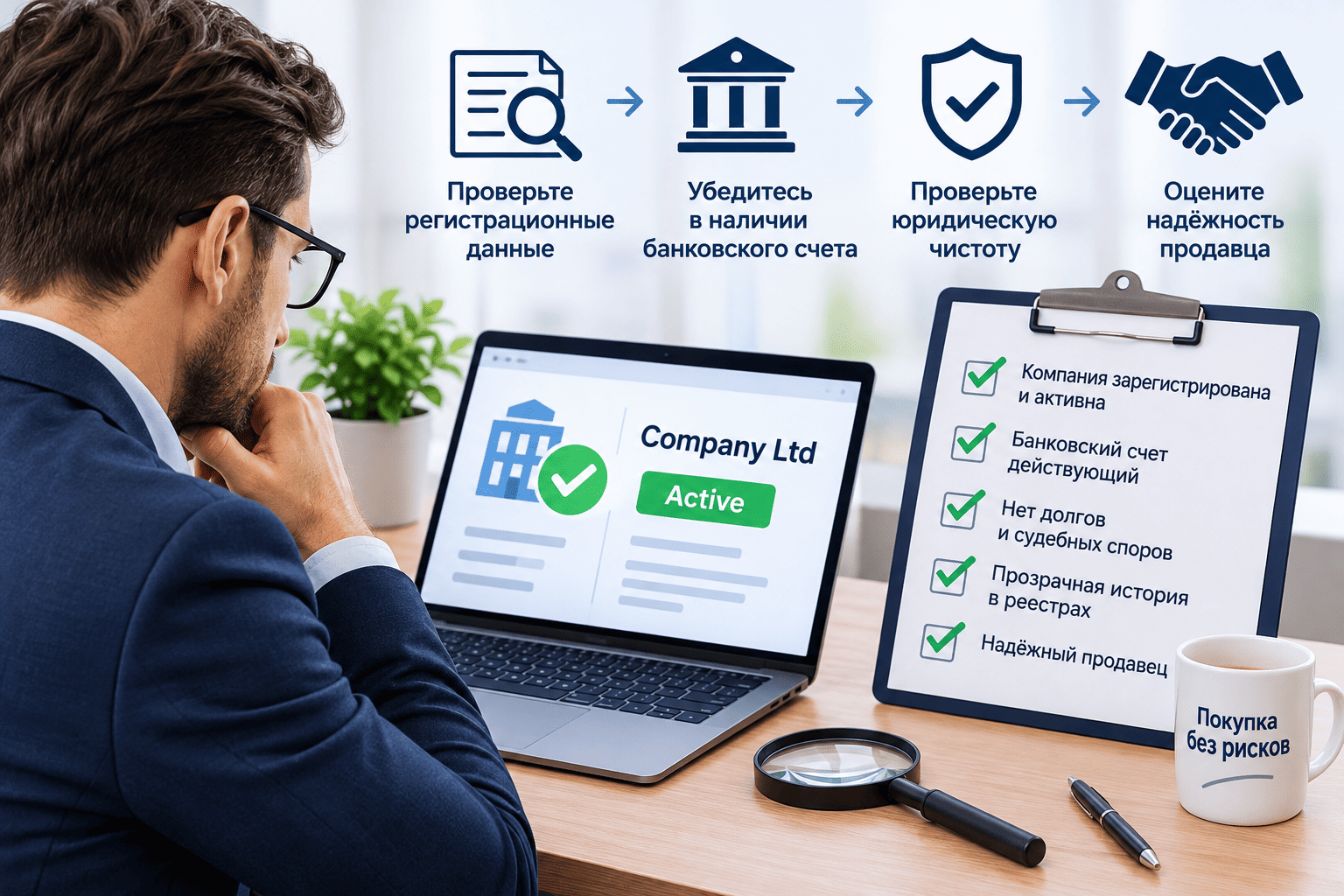
- You need a fresh Certificate of Good Standing, issued specifically for your transaction. A document from a previous year provides no information about what may have happened to the company since then.
- Screen all parties involved in the transaction—including yourself—against sanctions lists. The bank will do this regardless, so it is better to find out the results beforehand.
- While the use of nominee services is legal, both the bank and the register of beneficial owners must be able to identify the actual owner.
- The bank must approve the new owner before the share transfer documents are signed, not after.
- Make the final payment contingent upon receiving written confirmation from the bank regarding the new authorized signatory.
A ready-made company with an existing bank account starts at 20,000 euros, while a new British LTD can be registered starting from 999 euros. The bulk of this price difference is accounted for by the bank account. Although the account is the primary reason for the purchase, it is the very last thing to be verified—the process must always begin with the paperwork and the official registry.
Below is a verification procedure that we recommend following before transferring any funds. This applies whether you are purchasing from us or another provider, and it is suitable for buyers from any country.
Documents Provided by the Seller Before Payment
While the specific set of documents varies by jurisdiction, the core requirements remain the same. If a seller insists on providing scans only after receiving a deposit, move them to the bottom of your list.
Request complete scans—include every page, along with all stamps and notations. A cropped first page of the articles of association, for instance, fails to show who amended the document or when those changes were made.
Constitutive Documents and Internal Registers
At a minimum, the documentation should include:
- A certificate of incorporation (plus a certificate of name change, if applicable);
- The articles of association (or Memorandum and Articles of Association);
- Registers of shareholders and directors, as well as a register of beneficial owners (where maintained);
- Resolutions appointing the current director and authorizing the issuance of shares;
- Share certificates (if issued);
- An agreement with a registered agent, along with proof of payment for their services and any government fees for the current year.
Cross-reference the dates. A director appointed just a week before the sale, or shares transferred only a month ago, warrant further explanation. If a shareholder is a nominee, the seller must provide a declaration of trust; otherwise, it remains unclear who is actually selling the company.
Nominee services are legal—we provide them ourselves—but the actual beneficial owner must still be disclosed in bank questionnaires and the register of beneficial owners; the presence of a nominee director does not change this requirement.
An unpaid registered agent fee might seem like a minor issue, but it becomes a significant problem the moment a bank requests an up-to-date certificate. In offshore jurisdictions, failing to pay government fees causes a company to lose its "good standing" status—a fact that typically comes to light only when the bank is already waiting for the documents.
Certificate of Good Standing and Certificate of Incumbency
A Certificate of Good Standing confirms that a company is active, all fees have been paid, mandatory filings have been submitted, and there are no plans to strike the company from the register. In the UK, Hong Kong, and Singapore, this document is issued by the registrar, while in the Seychelles and other offshore jurisdictions, it is requested through a registered agent.
A Certificate of Incumbency lists the company’s directors, shareholders, secretary, and registered address as of the date of issuance. In jurisdictions without a public registry, banks use this document to verify the company’s structure.
You will need two sets of these documents: the first before the transaction, to verify what is being sold to you; and the second after the transaction—reflecting your own status as a director or shareholder—which the bank will request when updating your client information.
How to Verify Data Against the State Register
Documents provided by a seller are merely copies; a bank will always consult the official state register. Compare the company name, registration number, date of registration, status, address, board of directors, and—if the register discloses them—the shareholders or participants. Even a single mismatched letter in a director’s surname is reason enough to investigate further before making any payment.
Each jurisdiction has its own register and its own access fees.
United Kingdom
Searching the UK’s Companies House is free of charge. A company’s profile displays its current status, directors, persons with significant control (PSCs), the full history of filed documents, and the due dates for upcoming financial accounts and confirmation statements. The system explicitly flags any overdue filings.
As of November 18, 2025, identity verification is mandatory in the UK. New directors must provide a verification reference number upon appointment, while new persons with significant control (PSCs) must do so within 14 days. Verification can be completed via GOV.UK One Login or through an authorized agent; it is best to handle this before the transaction, as failure to do so will cause the formal transfer process to stall.
EU Countries
Germany’s *Handelsregister* has been open to the public free of charge since August 1, 2022, with no registration required. Poland’s KRS and the Czech *justice.cz* also provide free access to information regarding a company’s status and the composition of its management board. In the Estonian Commercial Register, in addition to the management board, check for records confirming the submission of annual reports. Such reports must be filed within six months of the end of the financial year, even if the company has had no turnover.
Beneficial ownership registers are more complex. Following a ruling by the Court of Justice of the European Union on November 22, 2022 (in the *WM* and *Sovim* cases), some countries have restricted or entirely closed public access to these records. While a buyer may not be able to view this information, a bank certainly will; therefore, it is essential to ensure that the new owner is registered in the system promptly following the transaction. If a company has a VAT number, verify it using the VIES system; it’s free and takes only a minute.
Hong Kong and Singapore
In Hong Kong, a "Company Particulars Search" from the Cyber Search Centre costs HK$22 and shows the date of the last annual return as well as the company’s composition. We have a separate article on purchasing a Hong Kong company that already has a bank account, which covers the specific fees, timelines, and due diligence requirements for Hong Kong.
In Singapore, a company profile can be obtained from ACRA via the Bizfile system. As of March 27, 2026, the party that submits the annual return will receive an updated company profile free of charge within 15 minutes of submission; this file remains available for download for 60 days. Ask the seller to provide this official Bizfile document rather than a manually typed-up extract.
Seychelles and Other Offshore Jurisdictions
There is no public registry of directors in the Seychelles. Verification must be conducted through an agent; therefore, it is best to obtain a "Certificate of Good Standing" or "Certificate of Incumbency" directly from the registered agent, rather than accepting a copy forwarded by the seller. You can verify an agent’s license by checking the list of licensed entities maintained by the Financial Services Authority.
By law, the records of an International Business Company (IBC) must be kept at its registered office in the Seychelles for at least seven years. Ask the agent to confirm whether these records are held there and for which years.
Sanctions Screening of Transaction Parties
The bank will screen the company, its former owner, and its new owner against sanctions lists. A match for any of them could lead to the closure of the account—or, in a worst-case scenario, the freezing of the funds held within it. A buyer who conducts their own screening at least knows what they are getting into.
The screening process is free and takes about half an hour. Search using full names (in Latin script, including various transliteration options), dates of birth, and both current and former company names.
Which Lists to Use
At a minimum, you should check the following:
- The UN Consolidated Sanctions List (based on UN Security Council resolutions);
- The EU financial sanctions database (easily accessible via the EU Sanctions Map);
- The UK Sanctions List (as of January 28, 2026, this is the sole official UK sanctions list; the former OFSI consolidated list has been discontinued);
- The SDN List and other OFAC-administered lists (accessible via the Sanctions List Search tool);
- The national sanctions list of the country where the account is held (if such a list exists separately).
Screen the seller, directors, and shareholders—tracing the entire ownership chain—as well as any major counterparties identified in the company’s records. If payments involving a sanctioned entity have passed through the account, the bank will hold you accountable for them.
The 50% Rule and Ownership Chains
In the EU and the US, blocking sanctions apply to any company that is 50% or more owned—directly or indirectly through a chain of entities—by individuals or entities named on a sanctions list. The EU formalized this threshold in its updated "Best Practices" guidance in 2024, while for OFAC, this has long been an established rule. The UK applies a different threshold: "more than 50%," and the stakes held by different sanctioned parties are generally not aggregated.
Consequently, checking only a single first-tier shareholder is insufficient. If the shares are held by a holding company, you must identify the ultimate beneficial owners—tracing them back to the actual individuals—and screen each of them against the sanctions lists.
The Buyer Through the Bank’s Eyes
A bank will vet you just as it would when opening a new account. Every bank maintains its own list of countries—covering both citizens and residents—with which it either refuses to work or imposes specific restrictions. Crucially, the bank focuses on the ultimate beneficial owner (UBO), not the country where the company is registered. Be sure to verify the requirements applicable to your passport and country of residence before selecting a company.
Using a nominee shareholder does not bypass these restrictions; the bank will still look at the actual beneficial owner. We do not assist in structuring entities for the purpose of circumventing sanctions or evading bank due diligence.
Debts, Business Activity, and Financial Reporting
Ready-made companies with existing bank accounts fall into two categories: those that have never conducted business, and those with a history of operations and turnover. For the former, due diligence is limited to confirming the absence of any business activity; for the latter, a near-audit is required.
We sell companies of the first type—those with no business activity or liabilities—though it is always advisable to verify this, regardless of the seller.
How to Confirm a Company Has Not Conducted Business
- A bank account statement covering the entire period since the account was opened, showing only capital contributions from the founder and bank fees.
- "Nil" (zero-activity) financial statements for all past periods—in the UK, these are referred to as "dormant accounts."
- A search of the company name and registration number within the judicial databases of the country of incorporation.
- A written assurance from the seller confirming the absence of contracts, employees, debts, or legal disputes; this should be incorporated into the share purchase agreement.
If the bank statement shows payments to third parties, request the corresponding contracts and invoices for each transaction. The bank will likely question the new owner about any unexplained incoming transfers—even those that occurred a year ago.
Taxes and Financial Filings
Even a company with no business activity is still required to file reports. A UK limited company (LTD) must submit annual accounts and a confirmation statement; an Estonian private limited company (OÜ) must file an annual report; and a Hong Kong company must submit an annual return, as well as tax returns upon request by the tax authorities. Always request proof of submission for each required filing from the most recent reporting period.
Penalties for late filing remain with the company, not the previous owner. Ensure the purchase agreement includes a clause requiring the seller to compensate for any fines or penalties incurred for periods prior to the share transfer, and specify the maximum amount for which the seller remains liable.
Bank Accounts and the Bank’s Response to a New Owner
While the company registrar can process the change of ownership quickly, the bank will treat you as a new client—even though the existing account agreement remains in place.
What to look for in bank statements
Request a statement covering the entire lifespan of the account, rather than just the most recent month. The most reliable method is to have the seller export the statement directly from their online banking interface during a video call; this makes it significantly harder to forge.
Examine the statement to identify the source and origin of the initial deposit, check for any refunds or frozen funds, review maintenance costs, and ensure there are no outstanding commission fees. Look at the account activity over the last six months. Some banks place inactive accounts into a "dormant" or "sleeping" state, requiring a separate application to reactivate them.
Verify who the current authorized signatory is. Changing an authorized signatory at a bank is a separate process from updating the director in the corporate registry; for the bank, this specific change is what matters.
Re-KYC and beneficial owner disclosure
European AML (Anti-Money Laundering) directives require banks to re-verify a client whenever significant circumstances change—this includes changes to the beneficial owner or the director. As of July 10, 2027, these requirements will be directly enforced via EU Regulation 2024/1624. Under this regulation, a "beneficial owner" is defined as any individual who, directly or indirectly, holds 25% or more of the shares or voting rights, or otherwise exercises control over the company. In the UK, a "person with significant control" (PSC) is similarly defined based on a threshold exceeding 25%.
For the bank, you will need to provide the new owner’s passport and proof of address, a description of the business activities to be conducted through the account, projected turnover, the countries where counterparties are located, and documentation regarding the source of funds. Some banks also require video-based identity verification.
The procedure is as follows: the seller submits the buyer’s questionnaire to the bank and waits for a response; only then should the parties sign the share transfer documents. If you proceed in the reverse order, you risk becoming the owner of a company that the bank subsequently refuses to service.
Comment from IT-Offshore
"We advise the buyer not to commit any funds until the bank has provided a response regarding their questionnaire. If a bank is unwilling to work with a new beneficial owner, the company may be transferred to you, but the account will be closed—leaving you to pay €20,000 for registration documents that would cost significantly less if purchased new. For this reason, our selection process begins by evaluating the bank, the buyer’s citizenship and residency, and their business profile; only then do we propose companies from our existing inventory that align with those specific criteria".
Risk of account closure post-transaction
An account may be closed—even after successfully passing KYC—if the actual business operations deviate from those originally declared. For example, if a company was acquired for consulting services but is subsequently used for cryptocurrency-related transactions, or if the turnover during the first few months proves to be ten times higher than what was stated in the application, the account is at risk.
Early warning signs typically include the bank requesting contracts for specific transactions, imposing limits, or delaying incoming transfers. It is essential to respond promptly and comprehensively, and to keep contracts and invoices for every major transaction readily available. Maintaining a second account with an EMI (Electronic Money Institution) or another bank can help mitigate the risks associated with relying on a single financial institution.
Activities involving cryptocurrency, payment processing, forex, or gambling require a license. We maintain a separate catalog of pre-licensed companies tailored for these sectors, including SEMI and SPI licenses in the UK, forex entities in Cyprus and Vanuatu, and crypto-related companies in Poland, the Czech Republic, and Lithuania.
Sale and Purchase Agreement and Settlement
The level of protection afforded to a buyer under a sale and purchase agreement depends on the detail with which the seller’s representations are set out. A standard one-page share transfer form facilitates the transfer of shares, but it provides no guarantees regarding the company’s debts or its bank accounts.
Key Provisions to Include in the Agreement
- The exact number and serial numbers of the shares being transferred, as well as the corresponding percentage of ownership;
- Representations from the seller confirming the absence of business activity, debts, legal disputes, employees, or outstanding fees/duties as of the transfer date;
- A representation confirming that neither the seller, the company, nor its beneficial owners appear on any sanctions lists;
- A comprehensive list of all items being transferred, including original corporate documents, the company seal (if applicable), online banking access credentials, security tokens, and the phone number and email address linked to the bank account;
- An obligation for the seller to sign director resignation letters and to assist with the bank’s KYC (Know Your Customer) procedures;
- Provisions for a full or partial refund should the bank reject the new beneficial owner within a specified timeframe;
- The governing law and the procedure for dispute resolution.
The phone number and email address linked to the online banking account are often overlooked until the last minute. Without access to these, the new owner cannot receive verification codes, and changing them requires going through the bank—a process that entails repeating the entire KYC procedure.
Settlement Procedure
The safest approach is to use an escrow arrangement—held by a legal professional or a bank—where funds are kept until all agreed-upon conditions are met. If an escrow arrangement is not used, divide the payment into three installments: the first upon verification of the documents, registers, and sanctions lists; the second upon the signing of the share transfer documents and the updating of the share register; and the final installment upon receipt of written confirmation from the bank that the new authorized signatory has been registered.
Never pay the full amount upfront to an unfamiliar seller—especially when using cryptocurrency. Recovering such funds in the event of a dispute is nearly impossible.
Timelines for Re-registration and Post-Transaction Steps
The overall timeline consists of two parts, with the banking process taking significantly longer.
How Long Re-registration Takes
For jurisdictions included in our catalog, we complete the change of director and shareholder in the registry within 24 hours of the documents being signed. In the UK, Companies House must be notified of a new director within 14 days.
The banking component is a separate process that depends on the specific bank. Expect this to take weeks, and avoid scheduling any major payments until you have received confirmation from the bank.
Legalizing Documents for the Buyer’s Country
You will likely need your corporate documents in your home country—for tax authorities, your bank, or a notary. If both your country and the country where the company is registered are parties to the 1961 Hague Convention, an apostille—issued by the competent authority in the country that produced the document—is sufficient. As of late June 2026, the Hague Convention has 130 signatories, including the UK, the USA, Hong Kong, Singapore, and the Seychelles. China joined in November 2023, Canada in January 2024, and Vietnam became a party on September 11, 2026.
If the destination country is not a party to the Convention—such as the UAE or Qatar—consular legalization is required. This typically involves a multi-step process—including a notary, the foreign ministry of the issuing country, and the consulate of the destination country—which can take weeks rather than days. Be sure to verify the specific requirements for your country in advance and order your documents well ahead of time.
Ensure that any translations comply with the regulations of the country where the documents will be submitted. Some jurisdictions require a translation with a certified translator’s signature, while others mandate the use of a sworn (official) translator. It is more convenient to order a bound set of documents with an apostille for the entire package; this way, you won’t have to reassemble it if you need it again later.
Tax Obligations of the Owner
Many countries have regulations concerning Controlled Foreign Companies (CFCs). Owners are required to disclose their interest in a foreign company—as well as its bank accounts—to the tax authorities in their country of residence. Depending on the size of the ownership stake and the nature of the company’s income, the company’s profits may be subject to taxation for the owner. Furthermore, under the Common Reporting Standard (CRS), banks transmit information regarding accounts and controlling persons to the tax authorities of their country of tax residence, provided that the country participates in the exchange. Since each country has its own specific deadlines and thresholds, it is advisable to consult with a local tax advisor before proceeding with a transaction.
What Is Included in a Sale
We offer ready-made companies with pre-existing bank accounts in 16 jurisdictions, including the UK, Germany, France, the Netherlands, Poland, the Czech Republic, Lithuania, Estonia, Serbia, Hong Kong, Singapore, the Seychelles, the USA, and Australia. Prices start at 20,000 EUR.
Upon purchase, the client receives a Certificate of Good Standing, official registry extracts, and bound sets of documents—all apostilled and delivered via courier to any location worldwide. We can also provide nominee services (with the ultimate beneficial owner disclosed to the bank) and handle annual reporting requirements. The entire process is conducted remotely.
To find the right solution, please contact us at sales@it-offshore.com or via Telegram. Please specify your preferred banking jurisdiction, the nature of your intended business, your citizenship, and your country of tax residence. This information will allow us to filter out options where a bank would likely decline your application.


